


EVERYTHING YOU WANT TO KNOW ABOUT ASSYRTIKO!
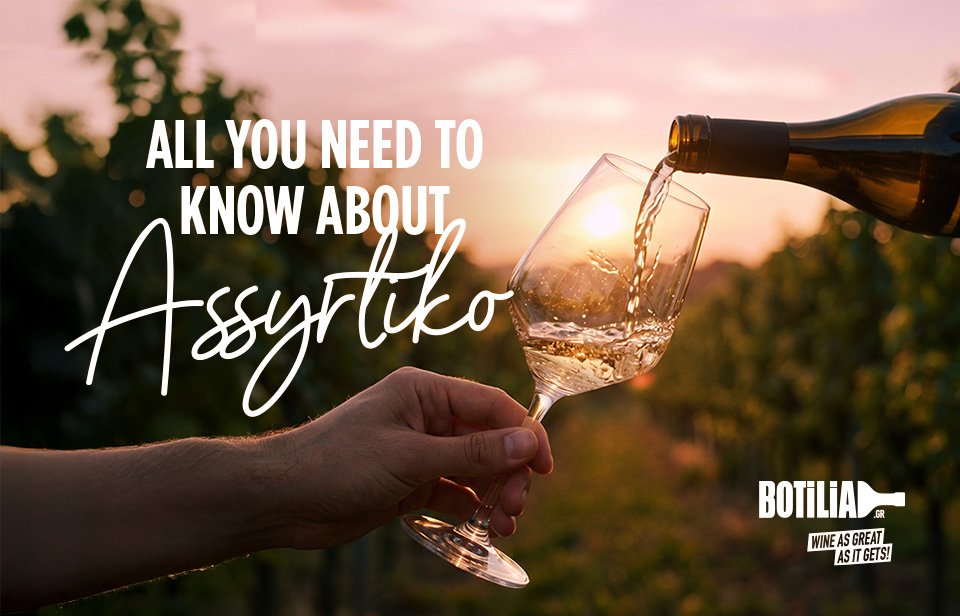
The Ultimate Guide to Greece’s Greatest White Wine!
Christina Tsoga – Wine Specialist, BotiliaLast updated: May 2026
Assyrtiko is an indigenous white grape variety from Santorini, renowned for its high acidity, intense minerality, and an aging potential exceeding 10 years. The first plantings on the volcanic island date back over 3,500 years. Today, it is cultivated throughout Greece, though Santorini remains the ultimate benchmark for quality. The typical style is dry, featuring bold lemony acidity, citrus aromas, and a signature mineral finish.
Quick Facts
| Characteristics | Details |
| Type | White grape variety |
| Origin | Santorini, Greece |
| First Mention | At least 3,500 years ago |
| PDO Zones | PDO Santorini, PDO Slopes of Meliton, PDO Rhodes, PDO Handakas-Candia |
| Acidity | Very High (pH 2.9–3.2) |
| Alcohol | Typically 13–14.5% ABV |
| Aging Potential | 10–15 years for premium labels; much longer for Vinsanto* |
| Typical Aromas | Lemon, lime, grapefruit, citrus blossoms, minerality (wet stone, flint) |
| Price Range | €12–€250 |
| Serving Temp | 8–10°C (young/stainless steel), 10–12°C (aged/oak-aged) |
What is Assyrtiko?
Assyrtiko needs no introduction. It is one of Greece’s most recognizable white varieties and serves as the flagship of Greek presence on the global wine map.
This is the guide I wish I had when I first started working with Greek wine a decade ago. It covers everything: what it is, how it’s made, why it stands out, who the top producers are, and—most importantly—which Assyrtiko to choose for every occasion and budget.
Assyrtiko is Greece's premier white grape. With its homeland in Santorini, it is world-famous for producing white wines with exceptional acidity, a distinct mineral backbone, and a rare ability to age—qualities seldom found in white wines produced in such warm climates.
While it may be a "recent discovery" for some, it is an ancient variety with an uninterrupted presence since the Bronze Age. Master of Wine Jancis Robinson notes in "Wine Grapes" that Assyrtiko is one of the few varieties globally that can rival Chardonnay in structure and Riesling in acidity and aging potential.
Where is Assyrtiko Grown?
Santorini: The Benchmark
Santorini is the heart of Assyrtiko. After the volcanic eruption, vines were among the few plants that managed to survive in the arid soil. The soil consists of pumice, volcanic ash, and mineral-rich rocks but is very poor in organic matter. This provides unique properties:
-
Phylloxera Resistance: The soil is hostile to phylloxera (the insect that destroys vine roots). Consequently, the Assyrtiko we enjoy today comes from ungrafted, original rootstocks—a rarity in Europe, where most vines were grafted onto American roots to survive the blight.
-
Marine Moisture Absorption: With annual rainfall under 300mm, the vines survive almost exclusively on nocturnal humidity absorbed by the porous volcanic soil.
-
The "Kouloura" & Ancient Roots: Vines can live for decades and are renewed via the "katavolada" technique (layering). This allows a vine to be "replanted" from its own ancient root, resulting in root systems that sometimes exceed 200 years in age. To protect the grapes from fierce winds and the scorching sun, the vines are trained into basket shapes called "kouloures."
PDO Santorini (est. 1971) protects this rare volcanic character. The wine must contain at least 85% Assyrtiko, with the remaining 15% allowed to be Athiri and Aidani.
Outside Santorini
In the last 20 years, Assyrtiko has been successfully planted across Greece:
-
Drama & Central Macedonia: Cooler climate, livelier acidity, more discreet minerality.
-
Nemea, Peloponnese: A Mediterranean expression with a fruitier profile.
-
Halkidiki: High altitudes offer nervous acidity and aromatic purity.
-
International: It is now grown in Australia (Jim Barry, Clare Valley)—the first export planting—as well as California, Oregon, Italy, and Israel, marking its evolution into an "international variety."
Taste Profile: What is Assyrtiko Like?
A typical dry Santorini Assyrtiko has the following characteristics:
Aromas
-
Primary: Lemon, lime, grapefruit, citrus peel oils.
-
Secondary: White flowers, citrus blossoms.
-
Mineral: Salinity, wet stone, flint.
Palate
-
Acidity: Very high, "crisp."
-
Body: Medium to full-bodied.
-
Alcohol: 12.5–15% (well-integrated).
-
Finish: Long, lemony, with subtle or intense minerality.
The minerality is unique. Tasters often compare it to Chablis or Mosel Riesling, but Assyrtiko has a distinctly "salty" finish, a result of both the volcanic soil and the sea influence.
Styles of Assyrtiko
- Dry Assyrtiko: The most common style, usually fermented in stainless steel to preserve freshness. Best consumed 1–5 years after bottling, though premium labels last much longer.
- Blends: Often blended with other varieties to provide structure and acidity, while the other grapes add aromatic intensity.
- Vinsanto:* A traditional sweet wine made from sun-dried grapes. Aged in oak for at least 2 years, resulting in aromas of raisins, dried figs, coffee, and nuts.
- Sparkling Assyrtiko: A newer development using both the Charmat and Traditional methods. Its high acidity makes it ideal for bubbles (e.g., Domaine Karanika).
- Oak-Aged Assyrtiko: Aged in French oak for at least 6 months, gaining volume and complexity (vanilla, honeycomb, smoke) without losing its mineral core.
- Nychteri: An iconic Santorini style aged for at least 3 months in oak with high alcohol (min 13.5%). Named after "night work" (nychteri), as grapes were traditionally processed at night to avoid high temperatures. It features a rich body with notes of honey and baked apple.
Food Pairing
Assyrtiko is one of the world's most versatile gastronomic wines.
| Food | Why it works |
| Grilled Octopus | Its saline nature embraces the oceanic flavor of the octopus. |
| Grilled Fish | Acidity balances the fat of the olive-oil-lemon dressing. |
| Spanakopita/Cheese Pie | Cuts through the richness of feta and butter. |
| Ceviche | Crisp acidity complements the lime character. |
| Sushi & Sashimi | A classic pairing for raw fish. |
| Feta & Artichokes | High acidity stands up to the "difficult" artichoke and salty feta. |
| Lemon Chicken | A harmony of flavors and aromas. |
| Taramosalata | Balances the saltiness and fishy character with mineral precision. |
Aging Potential
Assyrtiko is among the few white varieties that age exceptionally well.
-
Entry-level: 1–10 years
-
High-quality Santorini: 5–10 years
-
Premium Bottlings: 10–15 years (some 20+)
-
Nychteri: 7–20 years
-
Vinsanto: 30+ years With age, it develops notes of honey, beeswax, dried fruit, and characteristic "petrol" hints.
Top Producers
Within Santorini
-
Estate Argyros: Historic family; "Cuvée Monsignori" from 200+ year-old vines is a world rarity.
-
Domaine Sigalas: A benchmark producer that helped place Santorini on the global map.
-
Oeno P: Founded by Paris Sigalas, focusing on ultra-premium labels.
-
Vassaltis Vineyards: Modern winery in Vourvoulos; produces high-finesse, typical Assyrtiko.
-
Artemis Karamolegos: Active since 1952; produces exemplary wines in Exo Gonia.
-
Gaia Wines: Iconic presence; famous for aging Assyrtiko "Thalassitis" under the sea.
-
Hatzidakis Winery: Known for biodynamic approaches and exceptional single-vineyard expressions.
-
Santo Wines: A dynamic cooperative offering accessible and premium ranges.
-
Canava Chryssou - Tselepos: A successful collaboration highlighting Santorini's terroir.
-
Mikra Thira: The first winery on Thirassia island; produces ultra-elegant, "wild" volcanic wines.
Outside Santorini
Stavropoulos Estate (Ilia). Located in Paleochori, Ilia, Stavropoulos Estate captures the expression of Assyrtiko in the coastal regions of mainland Greece. Their wines exhibit intense minerality, salinity, and a robust structure that honors traditional winemaking through a modern and elegant approach.
T-Oinos (Tinos). In the village of Falatados, Alexandre Avatangelos and Gérard Margeon revived a 3,000-year-old vineyard set among granitic soils. The Assyrtiko they produce is world-class, boasting incredibly high minerality and standing as one of the most distinctive expressions of the variety outside of Santorini.
Messarea Winery (Tinos). A model of sustainability, this winery harmonizes a contemporary vision with tradition. Its history began in 2005 when the Papageorgiou family discovered a unique site filled with centuries-old olive trees, orange groves, and ancient vines. Their Assyrtiko possesses a strong island character, showcasing a primitive purity of fruit with a subtle "wildness."
Navitas Winery (Pieria). A new, modern venture by Maria Dimitriadi at the foothills of Mount Olympus, focusing on sustainable cultivation and ethical production. Their Assyrtiko combines elegance with mountain freshness, offering a "cooler," floral, and delicate version of the variety.
Chatzakis Winery (Syros). Nikos Chatzakis emphasizes highlighting the island’s unique terroir through small-batch productions. His Assyrtiko is distinguished by its structure and depth, featuring a strong flint (pyrite) element and exceptional aging potential.
Pavlidis Estate (Drama). Founded in 1998 by Christoforos Pavlidis in Kokkinogeia, Drama, the estate aims to produce high-quality wines that bear the hallmark of the region. Their Assyrtiko is a benchmark of the "continental style," featuring a rich body, creaminess, and citrus aromas that balance perfectly with the variety’s typical acidity.
Arktos Elevation Vineyards (Amydeon). The new venture by Artemis Karamolegos in Amyndeon brings the expertise of Santorini to an altitude of 700 meters. The result is an Assyrtiko that highlights the potential of the local terroir, with a commitment to detail at every stage of production.
Akrathos Newlands Winery (Halkidiki). Located in Halkidiki, this modern investment aims to showcase the region's historic vineyards through organic practices. Their Assyrtiko is expressive, featuring hints of salinity and lemony acidity.
Vaptistis Winery (Tinos). Yannis Moraitis spent years experimenting to create his own wine on his favorite island. His Assyrtiko comes from a privately owned vineyard at an altitude of 430 meters; the sandy-clay soil leaves a clear, distinct imprint on the wine.
Anatolikos Vineyard (Xanthi). Founded by the Nikolaidis brothers in Abdera, Thrace, this is the northernmost coastal vineyard in Greece. They create a "wild" and authentic Assyrtiko that highlights the coastal and sandy character of the terroir.
Muses Estate (Thebes). The Zacharias family has been cultivating vines in the Valley of the Muses since 1946, combining three generations of experience with modern techniques. Their Assyrtiko is fruitier and more accessible, maintaining the variety’s nerve and vibrancy but with "softer edges."
Vriniotis Winery (Evia). Based in Gialtra, North Evia, this winery fully utilizes the region’s extraordinary terroir. Their Assyrtiko features an intense flinty character and a velvety texture, consistently claiming its place among the best Assyrtikos outside the Cyclades.
Lyrarakis Estate (Crete). The family has been a pioneer in rescuing indigenous Cretan varieties since 1966. Their Assyrtiko comes from a dry-farmed vineyard at an altitude of 580 meters, offering unique aromas and a very elegant minerality.
Moschopolis Winery (Thessaloniki). Yorgos Germanis, with years of experience in the country’s largest wineries, experiments boldly with vinification techniques. The Assyrtiko grows in a dry, coastal vineyard and undergoes barrel aging and lees contact, resulting in the winery’s white flagship—a wine of incredible complexity, volume, and depth of flavor.
Karanika Estate (Amyndeon). Located on a slope on the shores of Lake Vegoritida, Laurens M. Hartman-Karanika and his wife Annette van Kampen focus on biodynamic cultivation and the méthode traditionelle. Their sparkling Assyrtiko is unique, transforming the variety’s explosive acidity into world-class finesse and bubbles.
Jim Barry (Clare Valley, Australia). This represents the most successful planting of the variety outside its homeland, producing remarkably typical results. Naturally, the clone was selected from the finest vineyards on the island (of Santorini).
Which Assyrtiko Should I Choose?
-
First-time Tasters (€9–25):
-
Everyday Premium (€25–35):
-
These prove why the variety is world-class.
-
Special Occasions/Cellaring (€35–60+):
- Skytali Hatzidakis Winery
- Gerontampelo Argyros Estate
- Akulumbo Oeno P
-
Vinsanto Late Release Argyros Estate
Premium single-vineyard expressions.
Preference Matcher:
-
If you drink Chablis/Sancerre: Santorini (stainless steel), Tinos, or Northern Greece.
-
If you drink Sauvignon Blanc: Assyrtiko blends.
-
If you drink Riesling: Assyrtiko with extended lees aging.
-
If you drink Oaked Chardonnay: Oak-aged Assyrtiko or Nychteri.
Assyrtiko vs. Other Whites: A Comparison
Assyrtiko vs. Chardonnay
-
Acidity: Assyrtiko is significantly higher.
-
Fruit Profile: Chardonnay leans toward tropical fruits; Assyrtiko focuses on citrus.
-
Minerality: Assyrtiko features salinity and "wet stone"; Chardonnay features flint (Chablis style) or graphite (California style).
-
Aging: Both varieties possess excellent aging potential.
Assyrtiko vs. Sauvignon Blanc
-
Aromas: Sauvignon Blanc is known for grass and bell pepper; Assyrtiko for citrus and wet stone minerality.
-
Acidity: Both have high acidity, but Assyrtiko’s is more "structured."
-
Aging: Assyrtiko has a clearly superior aging capacity.
-
Price/Value: Assyrtiko excels in the premium label category.
Assyrtiko vs. Riesling
-
Similarities: High acidity, minerality, aging potential, and "petrol" notes upon maturation.
-
Differences: Assyrtiko is saltier with a fuller body; Riesling is more aromatic and delicate.
-
Style: Assyrtiko is almost always dry, whereas Riesling covers a vast range (from bone-dry to sweet).
How to Serve Assyrtiko
-
Temperature: 8–10°C for fresh wines; 10–12°C for aged or oaked expressions.
-
Glassware: Standard white wine glass (Bordeaux white or all-purpose).
-
Decanting: Not necessary for young wines; aged bottles benefit from 15–30 minutes of aeration.
-
Preservation: 2–3 days in the fridge with a good cork and the use of a vacuum pump to remove oxygen.
FAQs
What does Assyrtiko taste like?
Assyrtiko is characterized by high, crisp acidity, aromas of lemon, lime, and grapefruit, and a distinctive saline minerality derived from the volcanic soil of Santorini. These are typically dry wines, ranging from medium to full-bodied, with a long-lasting finish.
Is Assyrtiko sweet or dry?
Assyrtiko is almost always dry. The exception is Vinsanto, a traditional sweet wine made from overripe, sun-dried grapes, which is aged in barrels for several years.
How long can Assyrtiko age?
Most Assyrtiko is consumed within 1–5 years of bottling. However, dry wines from Santorini can age for 5–10 years, while premium labels can last 10–15 years, and in some cases, 20+ years. Vinsanto is a special case and can age for over 30 years.
Which is the best Assyrtiko?
When looking for the finest Assyrtikos, all eyes turn to its birthplace. The premium Santorini category includes exceptional vinifications from Estate Argyros, Artemis Karamolegos Winery, Vassaltis Vineyards, and others.
How should Assyrtiko be served?
It is best served at 8–10°C in a standard white wine glass. It pairs exquisitely with seafood, grilled fish, grilled octopus, savory cheese pies, ceviche, and sushi. While it does not pair well with slow-cooked red meats, it is an ideal match for spit-roasted lamb and goat.
Assyrtiko or Chablis?
Both offer high acidity and minerality, but they differ in character. Assyrtiko has a more intense saline profile and a certain oiliness (viscosity), whereas Chablis features a "chalky" minerality.
Why is Santorini Assyrtiko more expensive?
Yields in Santorini are exceptionally low—among the lowest in the world (15–25 hl/ha compared to 40–60 hl/ha in regions like Burgundy or Bordeaux). This is due to the arid climate, volcanic soils, and the traditional basket-pruning method (kouloura). The presence of ancient vines and the ever-decreasing availability of cultivable land naturally drive prices higher.
Assyrtiko at Botilia.gr
Botilia.gr offers the most extensive collection of Assyrtiko in the Greek market—ranging from affordable everyday labels to premium aged selections and rare single-vineyard bottlings. Discover:
- Santorini Assyrtiko → All the top brands from the island.
- Premium Assyrtikos → Single-vineyard and aged expressions.
- Nykteri → The traditional aged style.
- Vinsanto → For the perfect sweet finish to a meal.
Christina Tsoga is a Wine Specialist at Botilia.gr
Last Update - May 2026