


ALL YOU NEED TO KNOW ABOUT ASSYRTIKO!
The Complete Guide to Greece's Greatest White Wine
Christina Tsogka - Wine Specialist, Botilia
Last updated, April 2026
⚡ Quick Facts
|
Feature |
Details |
|
Type |
White grape variety |
|
Origin |
Santorini, Greece |
|
First Recorded |
At least 3,500 years ago |
|
PDO Zones |
PDO Santorini, PDO Rhodes (as part of blends) |
|
Acidity |
Very high (pH 2.9–3.2) |
|
Alcohol |
Typically 13–14.5% ABV |
|
Aging Potential |
10–15 years for premium labels |
|
Typical Aromas |
Lemon, lime, grapefruit, apple, saline minerality |
|
Price Range |
€12–€80 |
|
Serving Temp |
8–10°C for fresh, 10–12°C for aged |
What is Assyrtiko?
Assyrtiko needs no introduction. If you drink Greek wine, you’ve already encountered it. If you don’t, this is probably where you should start!
This is the guide I wish I had when I first started working professionally with Greek wine ten years ago. It covers everything: what it is, how it’s made, why it stands out, who the top producers are, and most importantly for you, which Assyrtiko to choose for every occasion and budget.
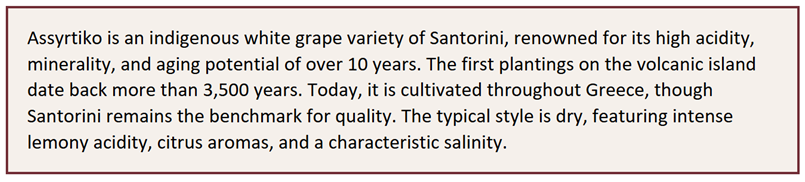
Assyrtiko is Greece’s flagship white grape variety. Its homeland is Santorini, and it is world-renowned for its ability to produce white wines with extraordinary acidity, a signature salty minerality, and a rare aging potential for a white wine produced in such a warm climate.
While some might surprisingly be discovering it just now, Assyrtiko is an ancient variety with uninterrupted production since the Bronze Age! In fact, Master of Wine Jancis Robinson includes it in the latest edition of "Wine Grapes" as one of the world’s most important white varieties, alongside Chardonnay and Riesling.
Where is Assyrtiko Grown?
Santorini – Its Point of Reference!
Santorini is the heart of Assyrtiko. The vines here continue to be cultivated using the kouloura pruning system. This is a traditional method of weaving the vine branches into a basket shape to create a protective "cell" against the island's fierce winds. It also serves as a shield for the grapes against intense sunlight and dehydration.
Santorini’s soils are a combination of volcanic ash, pumice, and lava. Their most significant properties are:
-
Phylloxera Resistance: The island's vines are own-rooted (afitrotos), a rare find in Europe, with some vines reaching 200 years of age.
-
Marine Moisture Absorption: Annual rainfall rarely exceeds 300mm; as a result, the vines survive almost exclusively on the nocturnal humidity absorbed by the highly porous volcanic soils.
The PDO Santorini consists of a minimum of 75% Assyrtiko, while the remaining 25% is comprised of the local white varieties Athiri and Aidani (either individually or in combination).
Outside Santorini
Over the last 20 years, Assyrtiko has been successfully planted in many Greek regions:
-
Drama & Central Macedonia: Cooler climate, brighter acidity, and more discreet minerality.
-
Nemea, Peloponnese: A Mediterranean expression with a fruitier profile.
-
Halkidiki: Low temperatures due to high altitude give the wine more vitality, with a nervous acidity and aromatic purity.
-
Australia (Jim Barry, Clare Valley): This was the first planting outside Greece, staying remarkably true to the variety's authentic style.
On the international stage, Assyrtiko is now cultivated in California, Oregon, Italy, and Israel, signaling its rise and evolution as an "international variety."
Taste: What is Assyrtiko like?
A typical Santorini Assyrtiko has the following characteristics:
Aromas
-
Primary: Lemon, lime, grapefruit, green apple, pear.
-
Secondary: White flowers, citrus peel.
-
Mineral: Flint, sea breeze, salinity, wet stone.
Palate
-
Acidity: Very high, crisp.
-
Body: Medium to full-bodied.
-
Alcohol: 13–14.5%, well-integrated.
-
Flavor: Long lemony and salty finish.