



WINE AND ARCHITECTURE. THE 5 MOST IMPRESSIVE WINERIES IN THE WORLD
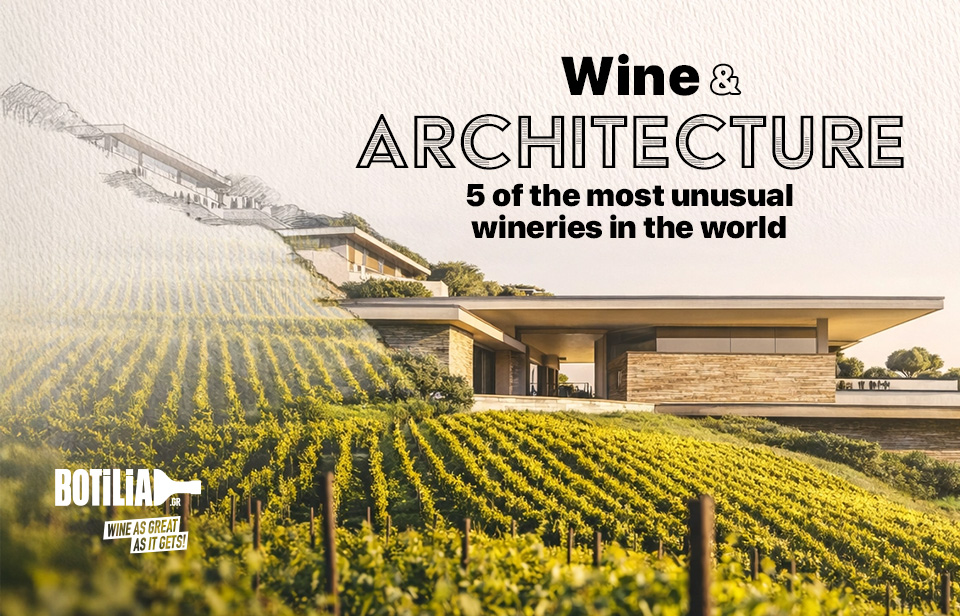
The relationship between wine and architecture is not merely functional. It is deeply cultural and often delightfully eccentric. Modern wineries may still be places where wine is produced, but they are increasingly evolving into true works of art spaces that tell stories about terroir, technology, and the vision of the people who imagined and designed them, offering visitors a far more immersive experience. Below are five of the world’s boldest and most architecturally iconic wineries.
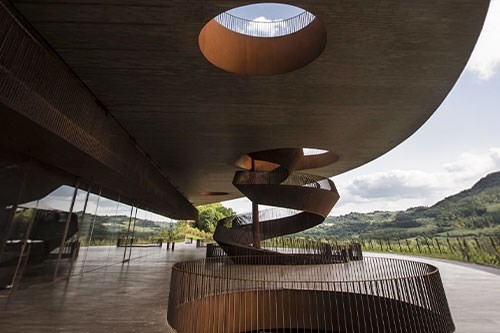
1. Antinori nel Chianti Classico, Chianti, Italy
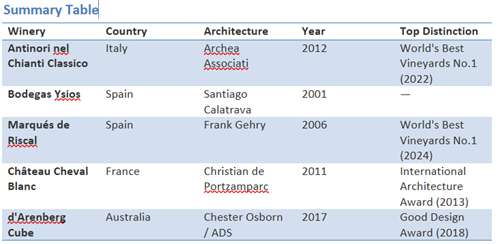
Antinori nel Chianti Classico is one of the most impressive examples of contemporary winery architecture, fully integrated into the Tuscan landscape. Designed by Archea Associati, the concept was to create a winery that disappears into the hills. Its roof is covered with vineyards that extend the natural lines of the terrain, while two vast horizontal cuts in the earth allow light to enter the interior, creating a striking interplay between underground architecture and panoramic views of the vineyards. The result resembles a natural geological formation rather than a man‑made structure.
In the underground spaces, natural coolness ensures stable temperatures for wine preservation and aging, while reducing energy consumption for cooling. It was voted No. 1 in the World’s Best Vineyards in 2022, an international recognition awarded by more than 500 wine and tourism experts.
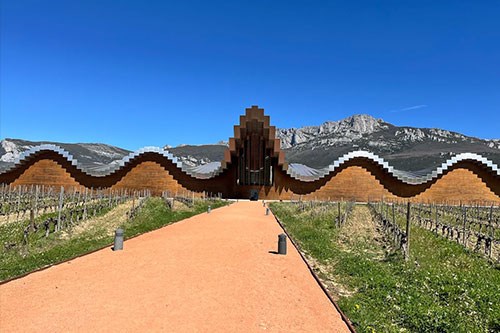
2. Bodegas Ysios, Álava, Spain
Designed by Santiago Calatrava, Bodegas Ysios is located in Laguardia, at the heart of Rioja Alavesa, and is one of Spain’s most emblematic wineries. Its signature undulating roof, made of aluminum and wood, mimics the ridgelines of the Sierra de Cantabria, creating a sense of natural continuity between the building and its surroundings.
Its name pays tribute to the Egyptian gods Isis and Osiris, associated with agriculture and the fertility of the land. The water channels surrounding the winery also reference Egypt, evoking the Nile, while their reflections enhance the monumentality of the structure. Two parallel walls, each 200 meters long, create a sense of movement, and the visitor area appears to float above the vineyards. Inside, a linear layout guides visitors from the reception area toward the vineyards, ending in the fermentation and aging rooms.
Although completed in 2001, it gained broader recognition in Greece after 2004, when Calatrava became widely known to the Greek public through the iconic roof of the Athens Olympic Sports Complex.
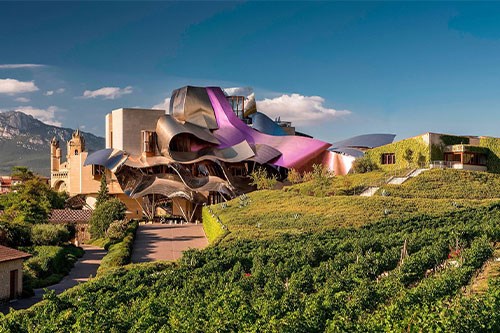
3. Marqués de Riscal, Rioja, Spain
Marqués de Riscal is one of the oldest and most historic wineries in Rioja, with roots dating back to 1858. It stood out as the first to introduce French winemaking techniques to the region, and in the early 20th century it wrapped its bottles in a golden wire mesh to guarantee authenticity and protect against counterfeits.
To honor this pioneering spirit, the estate collaborated with Frank Gehry the architect behind the Guggenheim Museum in Bilbao and the Walt Disney Concert Hall in Los Angeles. The result is a sculptural composition of titanium and stainless steel, with curved surfaces that seem to float above the 19th‑century cellars. The metallic ribbons carry symbolic colors: pink titanium for the wine, gold for the signature mesh on the label, and silver for the foil capsule.
The complex includes a luxury hotel, a vinotherapy spa, a fine‑dining restaurant, and tasting rooms. It is considered a global landmark in wine tourism and was voted No. 1 in the World’s Best Vineyards 2024 both worldwide and in Europe.
4. Château Cheval Blanc Saint‑Émilion, France
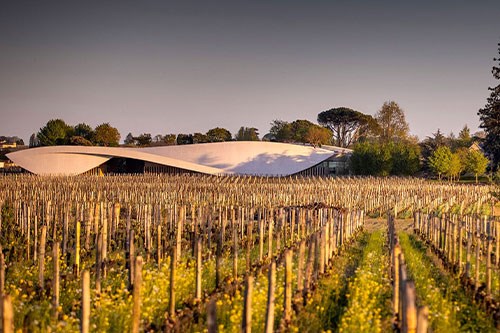
Designed by Pritzker Prize laureate Christian de Portzamparc, the Château Cheval Blanc winery was inaugurated in June 2011. It appears to rise from the earth like white concrete waves, forming an artificial slope covered with vegetation that blends harmoniously with the centuries‑old vineyards.
Inside, natural light highlights 52 concrete vats each corresponding to a specific vineyard plot, reflecting a philosophy of precision winemaking translated into architectural form. The cellar functions as a crypt with natural ventilation, ensuring ideal aging conditions.
In 2013, it received the International Architecture Award from the Chicago Athenaeum and the European Centre for Architecture Art Design and Urban Studies, and it holds HQE (High Environmental Quality) certification for energy efficiency and water management.
5. d’Arenberg Cube, McLaren Vale, Australia
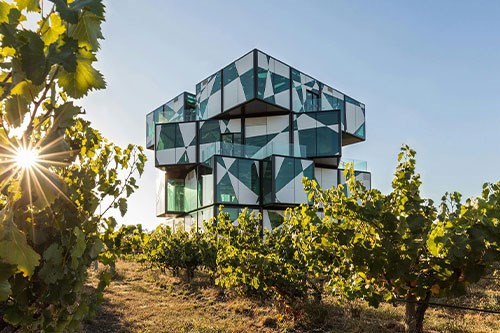
In an attempt to capture the complexities of winemaking, Chester Osborn thought of the Rubik’s Cube — and decided to build one among the vineyards of McLaren Vale. The d’Arenberg Cube was designed by Osborn himself in collaboration with ADS Architects, aiming to merge architecture, art, and wine experience.
The idea was initially met with skepticism by his family, but Osborn persisted and created a five‑story building with bold geometric forms that combine technology, art, and tasting experiences. The 360° tasting room at the top is an experience in its own right.
The project received the Good Design Award 2018, one of Australia’s top distinctions for design and innovation, as well as the International Best of Wine Tourism Award 2018 in the Architecture & Landscape category.
These five wineries remind us that wine has never been just a beverage. It is culture, art, and landscape intertwined and sometimes, the architecture that shelters it tells a story just as captivating as the one inside the bottle.

Christina Tsogka
Wine Specialist