


NEW WORLD VS OLD WORLD SAUVIGNON BLANC
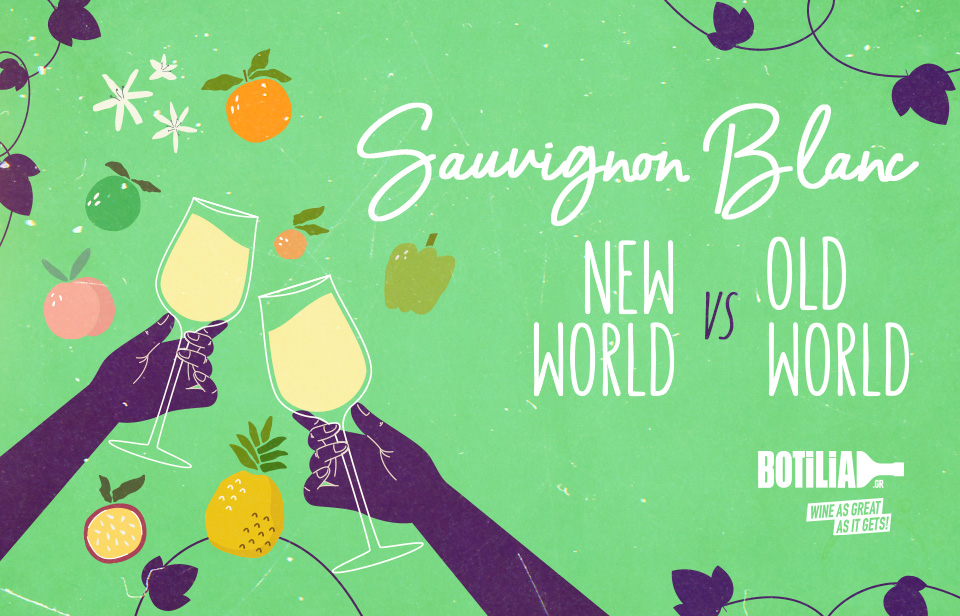
Sauvignon Blanc is one of those grape varieties that stands out among many recognizable even with your eyes closed. It is lively, aromatic, and always full of energy, whether it comes from the cooler vineyards of Europe or from sunnier parts of the world. In every case, it distinguishes itself through its fresh, green aromas, its vibrant acidity, and its ability to clearly express the climate and soil in which it grows. From crisp, lemony wines to more tropical expressions, Sauvignon Blanc always finds an audience and remains one of the most widely planted varieties in the world. Its name is linked to its high productivity sauvage* (wild) which requires careful control in order to yield grapes of exceptional quality. At the same time, it has proven so adaptable that today it is cultivated in many regions, both in the Old World and the New.*
And this is where things get interesting, because Sauvignon Blanc does not have just one identity, but two completely different ones. In the Old World it expresses itself with finesse and purity, while in the New World it becomes more aromatic, more intense, more extroverted. Two worlds and two philosophies for a variety that adapts and transforms in remarkably impressive ways.
Old World Sauvignon Blanc
In the Old World, Sauvignon Blanc shows a more restrained and elegant expression, with a pronounced mineral character. France is the “queen” country of the variety, as it is the 3rd most planted grape there and produces some of its most iconic examples.
In Southern France, in the Languedoc‑Roussillon region, the vast vineyard areas lead to large quantities of wine in a more everyday, less strict style. But in its birthplace, the Loire Valley, it excels thanks to its limestone soils. Sancerre and Pouilly‑Fumé are considered benchmarks for Sauvignon Blanc and are among the most famous names, attracting the most dedicated enthusiasts. They produce dry wines with intense, refreshing acidity and minerality, with aromas of lemon, green apple, white flowers, and fresh herbs often with a characteristic smoky note, especially in Pouilly‑Fumé due to the flint-rich soils. Because the soils do most of the work here, winemaking is kept as gentle as possible, with fermentation in stainless steel tanks and minimal or no use of oak, while the wines often rest on their lees for added texture. Notable examples include Comte Lafond Sancerre Grande Cuvée 2023 from Baron de Ladoucette and Sancerre Blanc Cuvée Silex 2023 from Domaine Serge Laloue.
Wines of this style shine alongside shellfish, fresh goat cheeses, and grilled fish.
In Bordeaux, the style is different. You’ll find Sauvignon Blanc blended with Semillon and occasionally Muscadelle, though there are now excellent single‑varietal bottlings as well. The Pessac‑Léognan region is considered top-tier for premium, age‑worthy white Bordeaux, offering a more classic style with rich structure and intense herbal aromas of green pepper, grass, and vine leaves. Oak is used here too, adding notes of spice and vanilla.
In the Graves region, Sauvignon Blanc contributes to the production of the sweet wine Sauternes, blended with a higher proportion of Semillon. Its characteristic acidity brings liveliness to the sweet Sauternes.
Italy offers yet another Old World expression, with a fresher and more invigorating profile, again with regional variations. In Trentino Alto‑Adige, with a notable example being Vette di San Leonardo, it shows sharp acidity and strong minerality, with citrus aromas and a more herbal character. In Friuli–Venezia Giulia, with the wonderful Areore from Scarbolo, it gives riper fruit mainly peach more intense herbaceousness, and a fuller palate. Aromatically it becomes quieter as we move toward Piemonte, where it is less explosive but more mineral, less vegetal, and with more restrained fruit (the Pian Craie from Il Falchetto is a must‑try). These styles pair beautifully with seafood, light fish or chicken dishes with lemony sauces, fresh soft cheeses, and salads.
New World Sauvignon Blanc
In the New World, the variety’s more cheerful and tropical character dominates, as the grapes ripen in warmer climates and produce bolder wines with high acidity, juicy fruit, and explosive aromas. Winemakers here face a major challenge: preserving the aromatic character of the variety through their chosen techniques.
The region that redefined the style of Sauvignon Blanc is Marlborough in New Zealand, though excellent examples also come from Australia, Chile (try Bicicleta from Cono Sur), South Africa, and California. Winemaking is mainly done in stainless steel to maintain purity and aromatic intensity. In California and South Africa, however, oak and lees aging are also used, giving fuller body and creamier texture a winemaker’s trick to combine freshness with complexity. Aromas lean toward tropical fruit such as passion fruit, mango, guava, and pineapple, as well as citrus like lime and grapefruit, along with fresh grass and green pepper. In New Zealand, the style combines tropical fruit with herbal notes, with a classic example being Holdaway Vineyard from Blank Canvas, which practically pulls you in by the nose. In South Africa, the fruit is riper and the acidity more pronounced, while in California the style is more lemony and less green, with Fumé Blanc wines experimenting with oak.
These styles are ideal with Asian cuisine, spicy dishes, or raw preparations like ceviche.
All of the above certainly help clarify things a bit, but if you absolutely must choose one style, unfortunately we can’t help you because we love them all! The best way is to taste them and you may end up agreeing with us. That’s all!
Christina Tsogka
Wine Specialist